

You run a small or micro business and your competitors are HUGEEE companies, with big headcounts and unlimited marketing budgets. You take a look at your own tiny SEO budget and think… how am I ever going to beat them? They have all the budgets to buy all the good quality backlinks they want, and I’ll NEVER be able to catch up to their rankings!
Fret not, I am in the same boat. Our competitors are big named digital marketing agencies with a headcount of around 50 staff or more… and I am a solo founder taking them on from the bedroom of my HDB in Singapore!
Yes, there are multiple ways to compete that don’t necessarily involve SEO. You can do manual cold outreach B2B lead generation, you can run Meta ads, or you can choose different keywords to rank for.
However, for this article’s sake, we’ll be keeping it to analysing the number of backlinks your website needs to get on the first page of Google.
The True Number: How Many Backlinks Do You Actually Need?
It is normal to feel intimidated by your competitors. You input their domain into SEMrush or Ahrefs, and you see they’ve accumulated tens of thousands of backlinks. Outperforming them in search engine results can seem like an impossible task.
However, by examining your backlink gap with top competitors, you can estimate what it might actually cost for your site to rank in the top search results on Google.
Here is an example. When I put one of my top competitors into SEMrush, at first glance, it seems like they have 71,100 backlinks. Does that mean I need to pay $83 × 71000 = $5.8 million to beat them in search engine results?

That’s astounding and almost impossible.
The TRUTH is, your competitor does NOT have 71100 backlinks! Let me explain how to get close to the real number.
Not all backlinks are created equal.
Here’s an example of spammy backlinks from my competitor. Google devalues these backlinks. But note, they are still counted by most backlink analysis software!

For counting purposes, you can ignore poor quality backlinks built through dubious strategies. These include backlinks placed in the footer of other websites, on forums, or in blog comments. You can filter for editorial only links through SEMrush or Ahrefs filters.
According to an Ahrefs study, the average backlink costs $83 USD. Note that this is before factoring in your content costs if you’re providing a guest post in exchange for a backlink. This concurs with my experience, and I discuss the true affordability of quality backlinks for small businesses in a Singapore context.
There are backlink service providers on Fiverr that offer backlinks for $5 a pop. You’re free to try them at your own risk! (I wouldn’t!)
Either way, high quality links are placed in editorial content, from high quality, relevant sites.
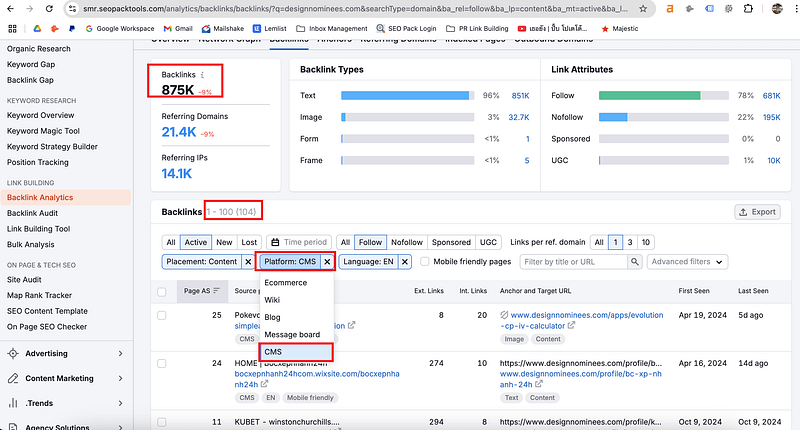
On first look, the example shown above looks like they have 875K backlinks, but on second filter, they only have active backlinks from 104 domains that are placed in the content and are in English.
SEMrush and Ahrefs are able to get you the quantity of backlinks, but they aren’t able to get you the quality of backlinks. For that, we’ll have to look at Majestic SEO. For competitors that have tens of thousands of backlinks, you must have a way to filter without going through it all manually, right?
Enter the topical trust flow metric from Majestic SEO.
Using Majestic SEO to Filter Relevant Sites
Through Majestic SEO, you can narrow down your backlink gap based on quality and relevance of backlinks.

For our SEO process, I prioritise relevancy first, followed by organic traffic, and then domain rating or authority. I hold the opinion that domain rating and domain authority are vanity metrics. The crazy part? DR and DA are extremely common used metrics amongst majority of the SEO community.
While they can still be used as a rough gauge, they are easily gamified, and these metrics should be taken with a pinch of salt.
The key issue here is relevancy.
How do you measure the relevancy of a backlink? For example, if you’re a law firm providing legal services in Singapore, you have no business getting backlinks from education websites from the US.
So, if your competitor has hundreds of backlinks, how can you analyze the quality of their backlinks without going through them one by one?
Majestic SEO uses a metric called trust flow. Trust flow determines the relevancy of a site through the quality of backlinks pointing to it. Majestic SEO also further categorise the domain of the backlink by topical niches.
You can make the assumption that the higher the topical trust flow for a niche related to your industry, the higher quality the website is.

For this example, this site is highly likely to be relevant to the Science/Astronomy category.
Looking for Relevancy Using Source Domain Topical Trust Flow
You can input your competitor’s domain in Majestic SEO, and manually filter for relevancy with the source domain’s Trust Flow.
I use the following filters:
- It is a Live Link
- It is DoFollow
- It is a Text Link
- It is Non Sponsored
- It is In Content (editorial links)
- Language is English
Make sure you are analysing the Root Domain, not just the URL! This pulls all backlinks pointing to all blogs, pages of the website, and not just the home page!

Majestic SEO is the only SEO backlink analysis tool out there that breaks down relevancy into a numerical form. To understand it in depth, you can read more about it here.
You can then mass export the filtered results.
Filtering Topical Trust Flow
Next, you can filter them further using source domain Topical Trust Flow. Majestic SEO assigns multiple Topical Trust Flow categories to each website. This means one website can have several topical trust flow categories.
I only consider backlinks from sites that have a source domain Topical Trust Flow rating of 10 and above from categories that are directly in my niche or niche related.
For example, web design and online marketing are niche related. Similarly, small business services and online marketing are parallel related. However, construction services and web design are barely related.
This filtering process is done manually on Excel.
I take the top three highest scoring categories, check if their scores are above 10, and ensure they are niche related.
This exercise should further reduce the total number of backlinks your competitors have. Next, I’ll further filter the remaining results using traffic indicators.
Using SEMrush to Filter Organic Traffic
Take the filtered results from the previous step in Excel and upload them into SEMrush’s bulk analysis. You can do this with Ahrefs as well.
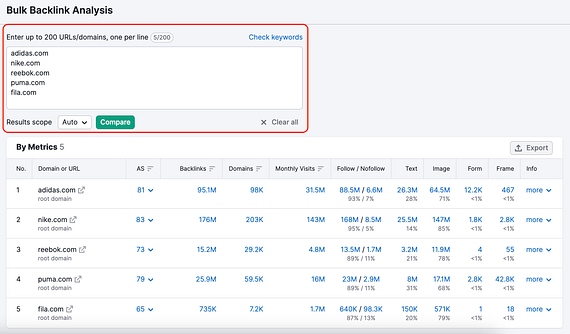
I then use SEMrush to filter by organic traffic, considering sites with fewer than 300 organic visits to be lower quality. Look at monthly visits.
You can adjust these numerical filters based on your SEO hypothesis. Sometimes, I’m okay with blogs that generate at least 100 organic visits if they have high quality content or exceptional relevancy (source domain Trust Flow above 20).
With SEMrush’s bulk analysis, you can pull the traffic data for these sites and match them side by side in an Excel sheet.
Now, you might ask, what about domain authority or domain rating? As mentioned earlier on, I don’t focus on domain rating or authority, as I consider them vanity metrics. I prioritise traffic and relevancy!
Final Filter: Excel Formulas to Filter Out Low Quality Backlinks
These SEO software tools are not perfect. The data that gets exported and filtered by their filters isn’t perfect.
I’d like to further remove backlinks from sites that are considered spammy and low quality, such as forum comments, blog comments, and directories. To be absolutely precise, yes you can hire a virtual assistant to manually identify scraper sites and backlink farms.
Yes, that’ll be extra cost and time. However, for a faster estimate, I use an Excel formula to flag some of these low quality sites.
=IF(
  OR(
    ISNUMBER(SEARCH(".xyz", A1)),
    ISNUMBER(SEARCH(".info", A1)),
    ISNUMBER(SEARCH(".tk", A1)),
    ISNUMBER(SEARCH(".top", A1)),
    LEN(A1) > 20,
    SUMPRODUCT(--ISNUMBER(MID(A1, ROW(INDIRECT("1:"&LEN(A1))), 1)*1)) > 3,
    LEN(A1) - LEN(SUBSTITUTE(A1, "-", "")) > 2,
    ISNUMBER(SEARCH("forum", A1)),
    ISNUMBER(SEARCH("directory", A1)),
    ISNUMBER(SEARCH("thread", A1)),
    ISNUMBER(SEARCH("directories", A1)),
    ISNUMBER(SEARCH("listing", A1)),
    ISNUMBER(SEARCH("discuss", A1)),
    ISNUMBER(SEARCH("discussion", A1)),
    ISNUMBER(SEARCH("board", A1)),
    ISNUMBER(SEARCH("list", A1)),
    ISNUMBER(SEARCH("classifieds", A1)),
    ISNUMBER(SEARCH("bulletin", A1)),
    ISNUMBER(SEARCH("faq", A1)),
    ISNUMBER(SEARCH("announcement", A1)),
    ISNUMBER(SEARCH("archive", A1)),
    ISNUMBER(SEARCH("community", A1)),
    ISNUMBER(SEARCH("Q&A", A1)),
    ISNUMBER(SEARCH("support", A1)),
    ISNUMBER(SEARCH("help", A1))
  ),
  "Flag",
  "Keep"
)
The great thing is that you can do most of the filtering manually in an Excel sheet. You do it once, then train a virtual assistant to handle it, so you don’t have to do the mind numbing work.
Your Final Backlink Gap
You’ll be surprised at the number of irrelevant backlinks your competitor has. That is because many SEOs rely on shortcut methods such as buying cheap links from dubious vendors!
Calculate Link Velocity Required
From here, things are straightforward. You can calculate your link velocity required, which is the rate at which you acquire backlinks, measured per month.
For example, if your competitor has 129 real backlinks, this theoretically means you need to build 22 backlinks per month for six months to catch up.
The estimated link building cost will be 129 × $83 ÷ 6 = $1785 per month. This is in USD. The costs estimated in this article do not include content writing expenses for content on your own website.
Yeah… good SEO isn’t cheap.
One concept to note here is that good content justifies links. If you have no content on your site, but just backlinks pointing to it, then you may signal to Google that you’re ‘hacking’ the algorithm. Hence, you’ll still need to produce great content alongside link building to be effective in SEO.
Conclusion
Today, quality and relevant backlinks are one of the top ranking factors for reaching page one. This is confirmed by Google’s recent API leak: https://growfusely.com/blog/google-api-leak/
Calculating your backlink gap provides a useful estimate of the number of backlinks needed, the cost that comes with it, and what it might take to compete effectively with top results on Google.
However, it is important to note that link building is not a be all, end all solution. In Google’s recent helpful content updates, they seem to signal that their algorithm has been leaning towards original, helpful on page content, topical authority and even branding signals.
