My SEO Process
You want to segment SEO into four different pillars so that you can have different staff, local and offshore to execute these processes together.
1st: Technical Site Audit, Content Audit, and Keyword Research.
2nd: Customer Research, Content Strategy
3rd: Outreach Handling, Backlink Acquisition Scale
4th: Transparent Link Documentation and Process Management
Pillar One) Site Audit, Content Audit, Keyword Research
Site audits are making sure your site functions healthily when it comes to Sitemaps, servers, site speed, links, HTTPS hosting issues, UI/UX issues. They keep your website healthy and functional.
Technical SEO is crucial because there is no point building backlinks and traffic to a site that isn’t working properly. I’ve managed SEO projects where the site had broken themes and plugins. These will indirectly disrupt your SEO efforts. You want your website to be technically sound before doing any changes or driving traffic to it.
To name a technical issue I faced: my first site grew to over 20K global traffic. The old hosts couldn’t handle the increase of traffic, and I had to switch hosts midway.
The basics, to name a few are: site find-ability/ index-ability checks, URL friendliness, On-Page SEO, and internal linking and backlink audits.
Pillar Two) Content Pillars, Customer Research and Architecture
There is HUGEEE misconception when it comes to SEO that all you have to do is publish content and you’ll automatically get traffic.
Ultimately, customers searching for content have pain points, they’re looking for solutions.
This is why you have to do some customer research and a content audit. First, a content audit helps map out your site’s architecture, and how it’s going to the built. You want to be ranking for the right keywords. Map out keywords to your current site’s content. This may require more content pillars, removal of thin content and rewriting existing content.
Secondly, you’ll want your content to fit into the user query (search intent) of searchers.
Pillar Three) Link Acquisition and Manual Outreach
No matter what SEOs tell you: white hat backlinks are going to move the needle.
There is no debate about it.
I’ve spent years finagling around site architecture, on-page SEO, keyword research, keyword density, and all the technical SEO you can think of. The variable that exploded my site from 1K to 20K traffic are white hat backlinks.
Link acquisition is the hardest part on SEO because they don’t break it down into processes. Most SEOs find link building overwhelming.
The key here is to hire an offshore team to execute your campaigns without doing everything on your own. Our email outreach campaigns for link building is managed by my offshore team.
Pillar Four) Link Documentation, Analysis and Reporting
Link documentation, analysis, and reporting form the fourth pillar because you need to track link quality. My team and I audit every single link that comes through. This creates transparency and allows progress tracking.
Effective link building requires strong data management skills. For example, our team regularly validates outreach databases using email verification tools to confirm addresses are deliverable. This includes ensuring data accuracy, managing different databases on Google sheets, and segmenting different portions of your lead base effectively.
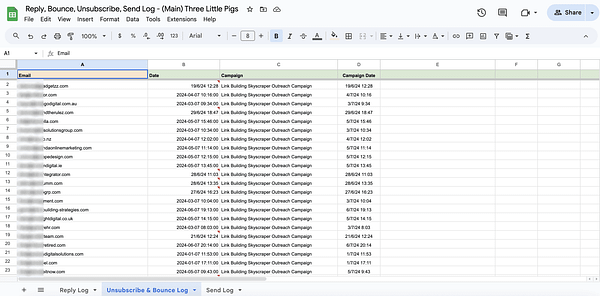
Secondly, you’ll want to document every single link built, the cost of content, and each task through this SEO project management process.
Note: our SEO agency uses transparent client-agency relationship management with detailed monthly reports, keyword traffic analysis, and documented link acquisition costs. Then there is a clear and systematic approach to tackle new keywords, content creation month on month and year on year.
//
ThreeLittlePigs.Pro Link Building Efforts to Get Out of the Sandbox
Our site started being “noticed” by Google, and we got into many of the top 100 rankings on local search engine results.
Here’s our backlinks growth and organic positions data:
I introduced an outreach focused link-building approach. This means getting real links from quality sites. You can fiddle around with technical SEO all you want, however, if you ask me link building is the KEY to moving the needle in your organic traffic and keyword rankings.
Link building Efforts in 2021 and 2022:
I began implementing SEO link-building strategies in September 2021, applying the same techniques I had successfully used on my first site.
| Month | Number of Backlinks |
|---|---|
| September 2021 | 4 |
| October 2021 | 1 |
| December 2021 | 8 |
| January 2022 | 1 |
| February 2022 | 2 |
| March 2022 | 2 |
| Total | 18 |
Link building Efforts in 2023:
Link building Efforts in 2024:

| Month | Number of Backlinks |
|---|---|
| June 2024 | 2 |
| July 2024 | 6 |
| August 2024 | 8 |
| September 2024 | 6 |
| October | 4 |
| November 2024 | 2 |
| Total Year to Date | To be Confirmed! |
The data here doesn’t include the domain authority of the sites we received links from, nor does it indicate the level of relevance of these sites.
To quantify relevance, I rely on Majestic’s SEO tool, focusing on each domain’s Topical Trust Flow. I only acquire links from domains that meet a specific threshold, ensuring they are either within my industry or a closely related niche.
This approach also helps standardize the link vetting process, providing clear guidelines for my SEO team to follow.
Social Signals
Our site isn’t really big on social media engagement. There’s not much likes or follows on our social media. It is arguable that social signals may be one of the factors that can help you “escape the sandbox”.
To help with that, you can run a paid social media engagement campaign on Meta ads. Or you can choose to leave it. I didn’t run any engagement ads. However, for basic social signals, you can get your Facebook profile, Instagram and LinkedIn company page up!
The Results: Out of the Sandbox?

Within four months of focused link-building efforts, our site moved from beyond page 100 to ranking on pages 3 to 5 in Google’s search results. It’s worth noting that our domain, ThreeLittlePig.Pro, is not ThreeLittlePigs.Sg, which might have provided an additional localized ranking signal boost.
Playing or harder mode demonstrates how brands can achieve keyword rankings without exploiting loopholes in Google’s algorithm.
Exact match domains continue to rank on the first page despite having weak backlinks and poor content. Yes, Google isn’t that sophisticated just yet.
Here are some examples of exact match domains:
- bestcreditcards.sg (ranking for “best credit cards Singapore”)
- plumbersingapore.sg (ranking for “plumber Singapore”)
- webdesignservices.sg (ranking for “web design services”)

Our agency got our first organic generated lead within two months of starting to publish content and link building. (Read: No, I’m not going to start shouting on social media that you can rank page one in two months)
One of our targeted pages is also ranked on the 4th to 5th page of local SERPs. However, despite continuing to build high quality links and publish content onwards in August 2024 (the 3rd month), there has been no movement on the search results.
That may… be alluded to the Google’s Sandbox.
You should also use Google Search Console to identify potential indexing issues.
Time for SEO to Work
The SEO community generally agrees that it takes 4 to 6 months on average for noticeable improvements in a website’s keyword rankings and organic traffic. This may correlate to the notion of a “Google sandbox”.
To second this, Ahrefs conducted a study on over 2 million keywords. They found that only 5.7% of newly published pages make it to the top 10 results on Google in one year.
